
Old School RuneScape's Varrock West Bank, rebuilt as a live peer-to-peer USDC exchange.


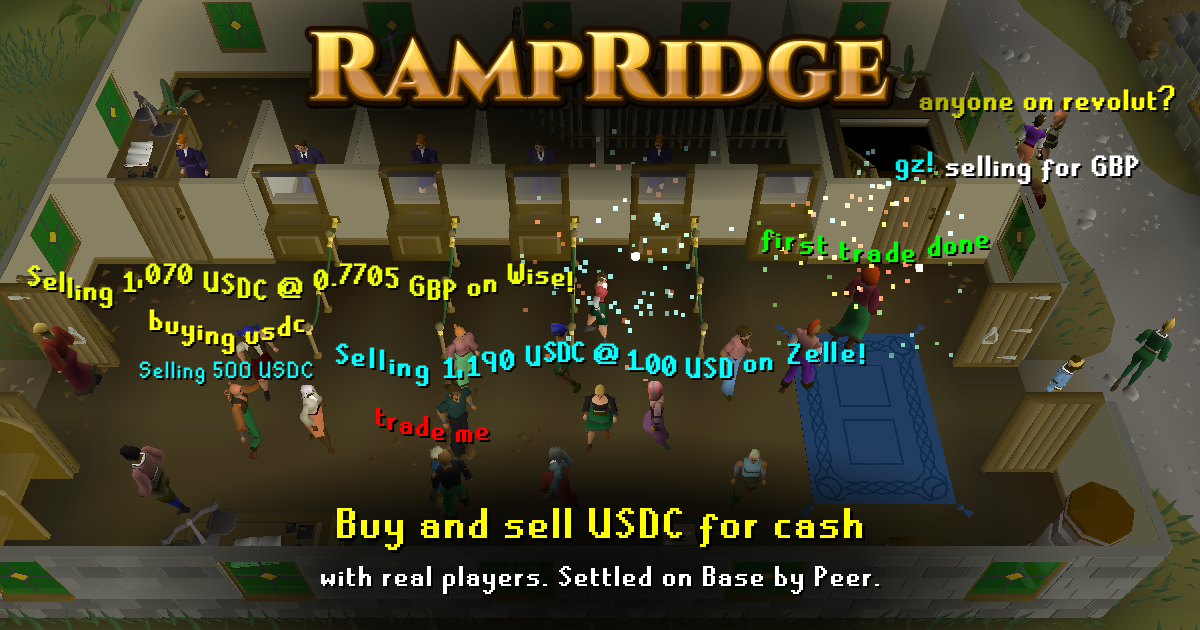
RampRidge is a browser game and a working exchange at the same time. You walk into the bank, chat with other players, and buy or sell USDC for real money with Revolut, Wise, Zelle, Cash App, Venmo, PayPal, Monzo and more. Every trade settles through the Peer protocol (ZKP2P) on Base: buyers pay sellers directly, prove the payment privately with the PeerAuth browser extension, and Peer's escrow contract releases the USDC. RampRidge never holds anyone's funds. The world is the original 2007-era bank, rendered with three.js and decoded from the game cache on your machine, with the original interfaces rebuilt in React.
Play it: www.rampridge.xyz
RampRidge is an unofficial fan project. RuneScape and Old School RuneScape are trademarks of Jagex Ltd. RampRidge is not affiliated with or endorsed by Jagex, and this repository contains none of the game's art, models, sounds or fonts (see Game assets).
- Features
- How it works
- Architecture
- Getting started
- Testing
- Documentation
- Project status
- Contributing
- Credits
- License
- Disclaimer
- A living bank. Walk on the original tile grid at the original 600 ms
tick, right-click for "Choose Option" menus, chat with the original
overhead effects (
red:wave:hello), emote, and switch between numbered worlds (301, 302, ...) like the original game. - Buy USDC with fiat. Pick the best live offer at a bank booth's Exchange (modelled on the Grand Exchange), or trade with a merchant NPC who shouts a real offer. Pay the seller directly, prove the payment with PeerAuth in Chrome or Brave on a computer, and the contract releases the USDC to your wallet.
- Practise first. A practice trade walks the trade window, the payment scroll, the proof and the Congratulations screen on a simulated seller, wallet and extension, with no login and no money. Every window says so.
- Sell USDC for fiat. Deposit USDC at the bank with your payout handle. Orders are priced at the live oracle rate, with an optional spread of -5% to +5%, and appear in the bank as items with their fills. Advertise one as a stall and other players in your world can trade with you.
- Send and receive. The USDC sits in your own wallet: send it to any Base address after a full review, or show your address and QR code to fund a sale.
- Logins without friction. Email, Google, an existing Peer account or any wallet, through Privy. Email and Google logins get a smart wallet on Base whose gas is sponsored.
- Built against scams. Chat filters payment handles, links, wallet addresses and contact details, because off-protocol trades are how people get robbed. Trades only settle through the bank's interfaces.
- Coverage. Buying spans 11 payment methods (including beta Alipay, UPI via Amazon Pay and X Money) and selling 11 platforms, both in the 11 major currencies Peer prices with a live oracle (USD, EUR, GBP, CAD, AUD, NZD, CHF, SGD, MXN, CNY, INR). The full matrix is in docs/design.md.
The engine (src/game) is plain three.js with no React: an OSRS-style camera,
tile pathfinding on the bank's real collision map, picking and context menus,
overhead chat effects, a minimap, and a port of the original model animation
runtime for players and NPCs. The interfaces (src/ui) are React components
drawn over the canvas with the original sprites and fonts: the chatbox, side
panel, bank, Grand Exchange, trade screens, dialogue and character designer.
None of that art lives in this repository. scripts/bake decodes the Old
School RuneScape cache (downloaded from the OpenRS2 Archive)
into public/game on your machine: the bank region as a GLB model, the
collision grid, the minimap, interface sprites, sounds, fonts and character
data. scripts/bake/assets.lock.json pins the cache production was baked
from and the size and SHA-256 of every file it serves, so a fresh clone can
rebuild the same assets and check them.
The bank runs as numbered worlds, each with its own players, chat and stalls,
on Firebase Realtime Database. Browsers may read one world at a time and
nothing else (database.rules.json). Every write goes through POST /api/act,
a Vercel function that authenticates the player's session token, validates
the action, rate-limits it and filters chat before writing with the Admin SDK.
A move writes only the path, a server start time and the run flag; every
client replays it deterministically (shared/protocol.ts). The server places
each arrival in the busiest world below 70% of its cap, so a quiet evening is
one lively bank rather than three empty ones. Operators open, cap and close
worlds from the database with no deploy. A world's realtime traffic grows with
the square of its size, so splitting players across worlds keeps the bill
down; docs/runbook.md has the measured numbers.
sequenceDiagram
    actor Buyer
    participant App as RampRidge (browser)
    participant Curator as Peer API (Curator)
    participant Base as Peer escrow on Base
    participant Ext as PeerAuth extension
    actor Seller
    Buyer->>App: pick an offer at the Exchange
    App->>Curator: quote (eligible offers only)
    App->>Curator: sign the intent (/v3/sign)
    App->>Base: signalIntent: the seller's USDC is reserved for this order
    Buyer->>Seller: pay the fiat directly (Revolut, Wise, Zelle...)
    Buyer->>Ext: prove the payment privately
    Ext-->>App: attested payment
    App->>Base: fulfillIntent with the proof
    Base-->>Buyer: USDC released to the buyer's wallet
The buyer has six hours to prove the payment. Peer's fee and RampRidge's 0.5% fee come out of the USDC received, and every confirm screen lists them. RampRidge waives its fee when the seller's order carries its Peer referral code, because Peer's referral share already pays it on those.
A seller deposits USDC into Peer's escrow contract with one or more payout handles. Buyers anywhere on Peer, in RampRidge or elsewhere, fill the order at the live oracle rate plus the seller's spread, and USDC only moves when a buyer proves they paid. Sellers top up or withdraw their orders from the bank.
- Funds only ever sit in the player's own wallet or in Peer's escrow contract on Base. RampRidge has no hot wallet and no custody.
- Fiat goes straight from buyer to seller. RampRidge never sees payment credentials; the PeerAuth extension proves a payment without revealing the account behind it.
- The server stores game data (players, chat, names, stalls, and a wallet address only if a player verifies one) and scrubbed telemetry. It checks announced trades on Base before it tells the room.
flowchart LR
    subgraph browser["Browser"]
        engine["src/game<br/>three.js engine"]
        ui["src/app, src/ui<br/>React shell and interfaces"]
        peer["src/peer<br/>buy and sell flows"]
        wallet["src/wallet<br/>Privy wallets"]
    end
    api["api/<br/>Vercel functions"]
    rtdb[("Firebase Realtime Database<br/>worlds/301..320")]
    curator["Peer API<br/>quotes and intent signatures"]
    chain[("Base<br/>USDC and Peer escrow")]
    ext["PeerAuth extension"]

    engine --- ui
    ui -- "POST /api/act (every write)" --> api
    api -- "Admin SDK" --> rtdb
    rtdb -- "read one world" --> ui
    peer --> curator
    peer --> ext
    wallet -- "transactions" --> chain
    api -- "verifies trades" --> chain
| Path | What it holds |
|---|---|
src/app |
React shell: boot, screens (loading, title, character design, game), providers, the global store |
src/game |
three.js engine (no React): world, entities, OSRS model animation, camera, input and picking, pathfinding, overhead text, minimap |
src/ui |
OSRS-styled interfaces drawn over the canvas: frame, side panels, bank, Exchange, trade, payment scroll, send, dialogue; src/ui/kit is the shared component kit |
src/net |
Realtime client: session token, world subscription, actions, world switching |
src/peer |
Peer protocol flows on @zkp2p/sdk and @zkp2p/cash: quotes, intents, payment proofs, deposits, refresh-safe recovery |
src/wallet |
Privy login, smart-wallet and external-wallet transaction senders, USDC send |
api |
Vercel functions: session, act (every world write), worlds, market, wallet, log, health, share, og, and the prune cron |
shared |
Wire protocol, movement replay, world rules, chat and name filters, shared by the API and the browser |
scripts/bake |
Asset pipeline from the OSRS cache to public/game |
scripts/ops, scripts/load |
Operator scripts (status, moderation, stuck orders) and emulator-only load and abuse tests |
dev |
Development harness pages for the engine, interfaces and UI kit |
tests |
Fork, parity and end-to-end suites that run outside bun run check |
The title screen downloads only the shell, the engine and the game assets.
The realtime client, Peer SDKs, Privy and WalletConnect load once the title
is idle or the player needs them; src/app/titleGraph.test.ts keeps them out
of the title's static import graph. CLAUDE.md goes deeper on
every part.
- Bun 1.2 or newer
- Node.js 22.18 or newer (Vite and the scripts run on it)
- The Firebase CLI and Java 17 or newer, for the Realtime Database emulator. No Firebase account is needed.
unzip, for the bake's font download- Chrome or Brave with the PeerAuth extension, only if you want to prove payments
git clone https://github.com/ADWilkinson/rampridge.git
cd rampridge
bun install

# Decode the game assets into public/game from the cache production was baked from.
# Downloads about 190 MB once (the cache and the fonts); later runs reuse .cache/.
bun run setup:assets

# Local settings: the defaults point the API at the emulator.
cp .env.example .env.local

# Terminal 1: the Realtime Database emulator on 127.0.0.1:9460
bash scripts/load/emulator.sh

# Terminal 2: the game and its API on http://localhost:5173
bun run dev
Working on the bake itself? bun run bake re-bakes from the cache in
.cache/osrs and rewrites the asset lock; scripts/bake/README.md
covers the pipeline.
Open http://localhost:5173 and press Play now. The dev server serves the
Vercel functions in api/ through a Vite plugin (scripts/dev-api.ts), and
both the API and the page use the emulator, never a live database. The API
answers 503 until FIREBASE_DATABASE_EMULATOR_HOST is set, so a missing
setting can't write anywhere real. Keep port 5173: it is the local origin the
production Privy client allows, so logging in works locally too.
Real money. The local game talks to Base mainnet and Peer's production API. Buying, selling or sending from a local build is a real transaction with real funds. Use small amounts, or test the money paths on a fork (Testing).
| To work on | You need |
|---|---|
The engine, interfaces and UI kit (/dev/*.html) |
The baked assets only |
| Joining a world, moving, chat, world switching | The emulator and SESSION_SECRET (both in .env.example) |
| Merchants' live offers and buy quotes | Network access to Peer's public API (no key) |
| Logging in | Nothing extra on port 5173 |
| Announced trades and stalls (the server checks them on Base) | BASE_RPC_URL (the public endpoint is fine) |
| Buying, selling and sending | A wallet with real USDC on Base, and PeerAuth to prove a payment |
| The prune cron | CRON_SECRET: call GET /api/cron/prune with Authorization: Bearer <secret> |
.env.example documents every variable.
With bun run dev running, these pages exercise one part at a time with
fixtures instead of live data:
| Page | What it shows |
|---|---|
/dev/ui.html |
The UI kit gallery |
/dev/bank.html, /dev/buy.html, /dev/send.html |
The bank, buy and send interfaces in every state |
/dev/dialogue.html |
Dialogue, How it works and Terms |
/dev/engine.html |
The engine with simulated players, merchants and a stall (?debug=1 draws the collision grid) |
/dev/actors.html |
Player and NPC models, walking, running and every emote |
/dev/bake.html |
Each baked output: world, minimap, sprites, items, interfaces |
/src/app/dev/shell-screens.html |
The shell's full-screen states and the HUD over fake wallet data |
| Command | What it checks | Needs |
|---|---|---|
bun run check |
Typecheck, lint (oxlint), the unit tests (Vitest), production build. Every change must pass it, and CI runs it on every push and pull request. Tests that read the baked assets skip when public/game is absent. |
bun install |
bun run test:fork |
The buy and sell money paths against Peer's deployed contracts on a local anvil fork of Base: deposits, intents, proofs, releases, smart wallets | Foundry's anvil, FORK_UPSTREAM_RPC_URL, network access to Peer's API |
bunx vitest run -c tests/send-fork/vitest.config.ts |
The USDC send path, including a send whose outcome was lost | anvil, FORK_UPSTREAM_RPC_URL |
bun run test:parity |
The buy path's intent signals, field by field, against the Peer web app's code and its real transactions on Base (tests/buy-parity/golden replays real fulfilments with its own config) |
anvil, an archive-capable FORK_UPSTREAM_RPC_URL, network access |
bunx vitest run --config dev/buy-e2e/vitest.e2e.config.ts |
A full buy through the real interface in headless Chrome, on a fork | Chrome, anvil, FORK_UPSTREAM_RPC_URL |
scripts/load |
Load and abuse tests: crowded worlds, floods, forged tokens | The emulator; see scripts/load/README.md |
FORK_UPSTREAM_RPC_URL is a Base mainnet RPC URL (for example an Alchemy
endpoint). The suites keep it out of their output, and they never send
anything to mainnet: transactions land only on the local fork, and the parity
suite reaches mainnet through a proxy that refuses every method that could
send or sign. tests/fork/README.md describes exactly
what is real and what is stood in.
| Document | Covers |
|---|---|
CLAUDE.md (also AGENTS.md) |
Architecture in depth, conventions and guardrails, for contributors and their coding agents |
| docs/design.md | The product spec: screens, interfaces, every state, the currency and payment matrix |
| docs/runbook.md | Operating production: deploys, worlds and their costs, incidents, moderation |
| tests/fork/README.md, tests/send-fork/README.md | The fork suites |
| scripts/bake/README.md | The asset pipeline |
| scripts/load/README.md | Load and abuse testing, with measured results |
| scripts/og/README.md, scripts/launch/README.md | Link preview cards and launch media |
RampRidge has been live since October 2026 and is actively maintained. The scope is deliberately one room: everything in the original game that isn't the bank is left out. Ideas that fit that room are welcome; see docs/design.md for what was deferred and why.
Contributions are welcome: bug fixes, interface fidelity to the 2007 client, performance, accessibility, and new payment methods as Peer adds them. RampRidge is one live bank rather than a template, so an improvement merged here reaches every player on the next deploy.
- Read CONTRIBUTING.md first, especially the rules for the code paths that move money.
- Open an issue before anything bigger than a small fix.
- Report security issues privately, as described in SECURITY.md.
The maintainer reviews pull requests and deploys main to production
(docs/runbook.md). This project follows the
Contributor Covenant.
- Peer (ZKP2P): the protocol every trade settles on, and
the
@zkp2p/sdkand@zkp2p/cashSDKs (MIT). - rs-map-viewer by dennisdev
(BSD-2-Clause): the cache decoders the bake vendors, and the model and
animation code
src/game/osrsports. - osrscachereader by Dezinater (BSD-2-Clause): the sound effect synthesiser the bake ports.
- RuneStar fonts: TrueType conversions of the game's fonts (conversion CC0 1.0; glyph designs Jagex's), fetched at bake time.
- OpenRS2 Archive: the source of the game cache.
- Cinzel (SIL Open Font License): the RampRidge wordmark.
- three.js, React, Privy, viem, Firebase and Vercel.
RampRidge's own code is released under the MIT License. Vendored third-party code keeps its own license, and the game assets are neither included nor covered: NOTICE has the details.
RampRidge is an unofficial fan project. RuneScape and Old School RuneScape are trademarks of Jagex Ltd. RampRidge is not affiliated with, endorsed by or sponsored by Jagex. This repository does not contain the game's art, models, sounds or fonts: the bake decodes them on your own machine from the public game cache.
RampRidge has no token and will not launch one. Coins using the name were launched by third parties and are not part of this project.
Trades are between people and settle through the Peer protocol's smart contracts; use of the protocol is subject to Peer's terms. The software is provided as is, without warranty of any kind. Nothing here is financial advice, and you are responsible for following the laws where you live.