

This package defines two classes, Zi and Qi, the Gaussian integers and Gaussian rational numbers, respectively.
Mathematically, the set of integers are denoted by
The Gaussian integers are denoted by
and the Gaussian rationals are denoted by
NOTE:
- Zi and Qi both support arithmetic mixed with each other, as well as ints, floats, and complex numbers; including the following operators:
+,-,*,/,//,**,%,==,!=,+=,-=, and*=. See the unittests in the tests directory for examples. - Python uses
$j$ instead of$i$ to represent complex numbers, so$j$ is the default unit symbol for Zi and Qi, however, that can be switched to$i$ if desired. Again, see the unittests for examples. - Although both Zi and Qi are subclasses of numbers.Complex, and (mathematically speaking)
$\mathbb{Z}[i] \subset \mathbb{Q}[i] \subset \mathbb{C}$ , the class Zi is not implemented as a subclass of Qi. - Many of the algorithms and examples here are from "The Gaussian Integers" by Keith Conrad
From a clone of this repository:
pip install .
or directly from GitHub:
pip install git+https://github.com/alreich/gaussian-integers.git
Requires Python 3.9 or later. Documentation: https://gint-project.readthedocs.io/en/latest/
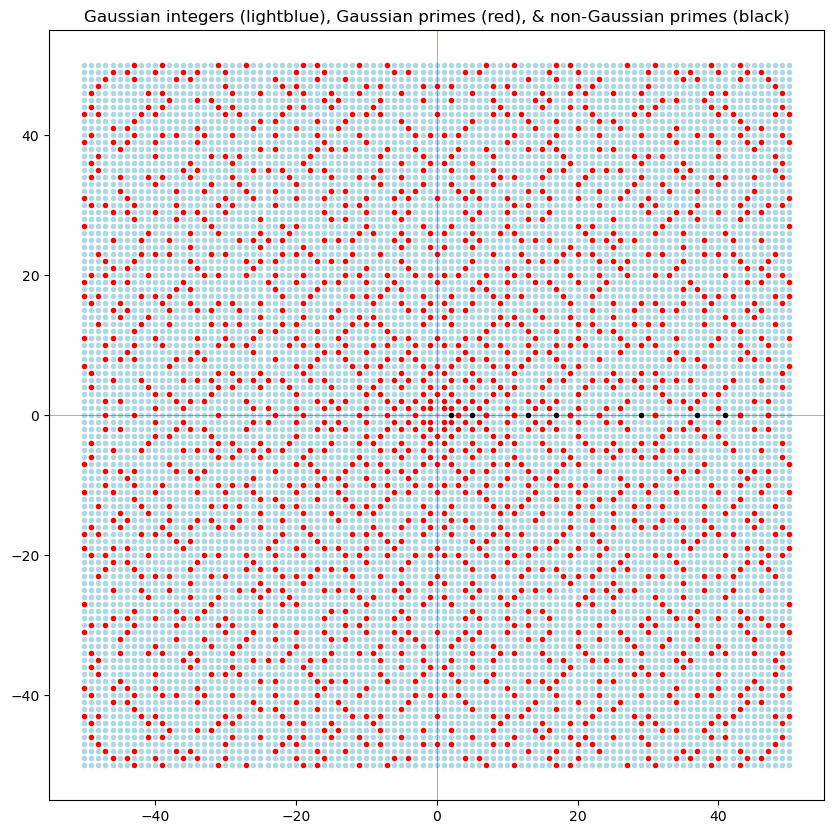
Just for fun, the following figure is a plot of Gaussian integers, Gaussian primes, and non-Gaussian primes.
Why not simply use Python's built-in complex numbers?
The reason is so that arbitrarily large Gaussian integers can be exactly represented.
Python's built-in complex type uses two floating point numbers, and Python floats are limited in size, whereas its integers are not.
To see this, consider the following calculation, where a number with a large number of digits is entered as an integer, n, and as a float, f, and observe how
n = 11111111111111111111111111111111111111111111111111111111111111111111111111111111111111111111111111111111111111111111111111111111111111111111111111111111111111111111111111111111
f = 11111111111111111111111111111111111111111111111111111111111111111111111111111111111111111111111111111111111111111111111111111111111111111111111111111111111111111111111111111111.0

print(f"{n = }")
print(f"\n{f = }")

print(f"\n{(n + 1) - n = }")
print(f"{(f + 1) - f = }")
n = 11111111111111111111111111111111111111111111111111111111111111111111111111111111111111111111111111111111111111111111111111111111111111111111111111111111111111111111111111111111
f = 1.111111111111111e+175
(n + 1) - n = 1
(f + 1) - f = 0.0
The Python module gint contains two classes, Zi and Qi, which represent a Gaussian integer and a Gaussian rational, respectively.
It is recommended that both Zi & Qi be imported, because some operations on Gaussian integers result in Gaussian rationals (such as true division of Zi's), and vice versa (such as Qi's with integer components).
from gint import Zi, QiThe string representation of a Zi will be its equivalent complex or integer value in string form.
A Zi can be created from two integers or floats (floats are rounded) or a single complex number.
z     = Zi(2, -3); print(f"{    z = } == {z}")
zero  = Zi()     ; print(f"{ zero = }  == {zero}")
one   = Zi(1)    ; print(f"{  one = }  == {one}")
two   = Zi.two() ; print(f"{  two = }  == {two}")  # norm = 2
i     = Zi.eye() ; print(f"{    i = }  == {i}")
a     = Zi(2-3j) ; print(f"{    a = } == {a}")
b     = Zi(-2.8, 5.2); print(f"{    b = } == {b}")
c     = Zi('2-3j') ; print(f"    c = Zi({str(c)[1:-1]!r}) == {c}")
d     = Zi('(2-3j)') ; print(f"    d = Zi({str(d)!r}) == {d}")
e     = Zi('5') ; print(f"    e = Zi({str(e)!r}) == {e}")
units = Zi.units() ; print(f"{units = } == {list(map(str, units))}")
z = Zi(2, -3) == (2-3j)
zero = Zi(0, 0) == 0
one = Zi(1, 0) == 1
two = Zi(1, 1) == (1+1j)
i = Zi(0, 1) == 1j
a = Zi(2, -3) == (2-3j)
b = Zi(-3, 5) == (-3+5j)
c = Zi('2-3j') == (2-3j)
d = Zi('(2-3j)') == (2-3j)
e = Zi('5') == 5
units = [Zi(1, 0), Zi(-1, 0), Zi(0, 1), Zi(0, -1)] == ['1', '-1', '1j', '-1j']
q    = Qi(2.4, 3.25)      ; print(f"{    q = } == {q}")
r    = Qi('12/5', '13/4') ; print(f"{    r = } == {r}")
s    = Qi('24/10', '26/8'); print(f"{    s = } == {s}")  # fractions are reduced to simplest form

t     = Qi('12/5+13/4j') ; print(f"    t = Qi( {str(t)[1:-1]!r} ) == {t}")
u     = Qi('(12/5+13/4j)') ; print(f"    u = Qi({str(u)!r}) == {u}")


zero = Qi()     ; print(f"{ zero = } == {zero}")  # Given integer values, a Qi "collapses" into a Zi:
one  = Qi(1)    ; print(f"{  one = } == {one}")
i    = Qi(0, 1) ; print(f"{    i = } == {i}")
q = Qi('12/5', '13/4') == (12/5+13/4j)
r = Qi('12/5', '13/4') == (12/5+13/4j)
s = Qi('12/5', '13/4') == (12/5+13/4j)
t = Qi( '12/5+13/4j' ) == (12/5+13/4j)
u = Qi('(12/5+13/4j)') == (12/5+13/4j)
zero = Zi(0, 0) == 0
one = Zi(1, 0) == 1
i = Zi(0, 1) == 1j
The usual properties of complex numbers are also supported for Gaussian integers:
- real part
- imaginary part
- norm
print(f"{z = }")

print(f"{z.real = }")
print(f"{z.imag = }")
print(f"{z.norm = }")
print(f"{z.is_unit = }")
z = Zi(2, -3)
z.real = 2
z.imag = -3
z.norm = 13
z.is_unit = False
The following operations can be performed on a Gaussian integer:
- conjugate
- compute absolute value
- convert to string
- convert to standard Python complex number
- negate
print(f"{z = }")

print(f"{z.conjugate() = }")
print(f"{abs(z) = }")
print(f"{str(z) = }")
print(f"{complex(z) = }")
print(f"{-z = }")
z = Zi(2, -3)
z.conjugate() = Zi(2, 3)
abs(z) = 3.605551275463989
str(z) = '(2-3j)'
complex(z) = (2-3j)
-z = Zi(-2, 3)
Most of the usual arithmetic operations that can be performed on complex numbers are supported, such as infix operators and in-place assignment operators.
Additionally, the arithmetic of Gaussian integers can be mixed with standard Python numbers (integers, floats, complex).
The following infix operators are supported: +, -, *, **, /, //, %
a * Zi(2.9)**-1Qi('2/3', '-1')
a = Zi(6, 12)
# b = Zi(1, -2)
b = 2.9
c = a * b

print(f"{a = }, {b = }, a * b = {c = }\n")

print(f"{a + b = }")
print(f"{a - b = }")
print(f"{a * b = }")
print(f"{a / b = }")  # In general, truediv will return a Gaussian rational,
print(f"{c / b = }")  #     unless b | c, in which case, a Zi is returned.
print(f"{a // b = }")  # floordiv uses round instead of floor.
print(f"{c % b = }")
print(f"{a**2 = }")
print(f"{a**0 = }")
print(f"{a**-1 = }")  # This will yield a Gaussian rational, except for units
print(f"{i**-1 = }")  # 1/i = -i
a = Zi(6, 12), b = 2.9, a * b = c = Zi(18, 36)
a + b = Zi(9, 12)
a - b = Zi(3, 12)
a * b = Zi(18, 36)
a / b = Zi(2, 4)
c / b = Zi(6, 12)
a // b = Zi(2, 4)
c % b = Zi(0, 0)
a**2 = Zi(-108, 144)
a**0 = Zi(1, 0)
a**-1 = Qi('1/30', '-1/15')
i**-1 = Zi(0, -1)
Mixed integer and Gaussian integer arithmetic is supported.
w = 2; print(f"{w = }")
print(f"{a = }\n")

print(f"{a + w = }")
print(f"{a - w = }")
print(f"{a * w = }")
print(f"{a / w = }\n")

print(f"{w + a = }")
print(f"{w - a = }")
print(f"{w * a = }")
print(f"{w / a = }")
w = 2
a = Zi(6, 12)
a + w = Zi(8, 12)
a - w = Zi(4, 12)
a * w = Zi(12, 24)
a / w = Zi(3, 6)
w + a = Zi(8, 12)
w - a = Zi(-4, -12)
w * a = Zi(12, 24)
w / a = Qi('1/15', '-2/15')
Mixed float point and Gaussian integer arithmetic is supported. Floats are rounded before being used.
print(f"{a = }\n")

print(f"{a + 2.1 = }")
print(f"{a - 2.1 = }")
print(f"{a * 2.1 = }")
print(f"{a / 2.1 = }\n")

print(f"{2.1 + a = }")
print(f"{2.1 - a = }")
print(f"{2.1 * a = }")
print(f"{2.1 / a = }")
a = Zi(6, 12)
a + 2.1 = Zi(8, 12)
a - 2.1 = Zi(4, 12)
a * 2.1 = Zi(12, 24)
a / 2.1 = Zi(3, 6)
2.1 + a = Zi(8, 12)
2.1 - a = Zi(-4, -12)
2.1 * a = Zi(12, 24)
2.1 / a = Qi('1/15', '-2/15')
Mixed complex number and Gaussian integer arithmetic is supported. Floats are rounded before being used.
print(f"{a = }")
d = 1.1-3.9j; print(f"{d = }")
d_rounded = Zi(d)  # Zi rounds floating point and complex values
print(f"{d_rounded = }\n")

print(f"{a + d = }")
print(f"{a - d = }")
print(f"{a * d = }")
print(f"{a / d = }\n")

print(f"{d + a = }")
print(f"{d - a = }")
print(f"{d * a = }")
print(f"{d / a = }")
a = Zi(6, 12)
d = (1.1-3.9j)
d_rounded = Zi(1, -4)
a + d = Zi(7, 8)
a - d = Zi(5, 16)
a * d = Zi(54, -12)
a / d = Qi('-42/17', '36/17')
d + a = Zi(7, 8)
d - a = Zi(-5, -16)
d * a = Zi(54, -12)
d / a = Qi('-7/30', '-1/5')
e = 1-4j

print(f"{a + e = }")
print(f"{a - e = }")
print(f"{a * e = }")
print(f"{a / e = }\n")

print(f"{e + a = }")
print(f"{e - a = }")
print(f"{e * a = }")
print(f"{e / a = }")
a + e = Zi(7, 8)
a - e = Zi(5, 16)
a * e = Zi(54, -12)
a / e = Qi('-42/17', '36/17')
e + a = Zi(7, 8)
e - a = Zi(-5, -16)
e * a = Zi(54, -12)
e / a = Qi('-7/30', '-1/5')
In-place assignment operators, +=, -=, and *= are also supported.
Here's an example that uses +=:
zi_sum = Zi()
int_sum = 0

for k in range(5):
    int_sum += k
    zi_sum  += Zi(k, k)

print(int_sum, zi_sum)
10 (10+10j)
Many of the algorithms and examples, below, are from "The Gaussian Integers" by Keith Conrad
For
help(Zi.modified_divmod)Help on function modified_divmod in module gint.zi:
modified_divmod(a, b)
Divide a by b, rounding the quotient to the nearest Gaussian
integer (rather than truncating), so that the remainder has
strictly smaller norm than b. Returns q & r, such that
a = b * q + r. This is what makes gcd/xgcd below terminate
correctly, since Z[i] is a Euclidean domain under the norm
only when division rounds to nearest.
Example
alpha = Zi(27, -23)
beta = Zi(8, 1)

gamma, rho = Zi.modified_divmod(alpha, beta)

print(f"{beta * gamma + rho} = {beta} * {gamma} + {rho}")

print(f"\nN({rho}) = {rho.norm} and (1/2)*N({beta}) = {(1/2) * beta.norm}")
(27-23j) = (8+1j) * (3-3j) + -2j
N(-2j) = 4 and (1/2)*N((8+1j)) = 32.5
The Euclidean Algorithm
Let
help(Zi.gcd)Help on function gcd in module gint.zi:
gcd(a, b)
A gcd algorithm for Gaussian integers.
Returns the greatest common divisor of a & b.
This function implements the Euclidean algorithm for Gaussian integers.
Example
alpha = Zi(11, 3)
beta = Zi(1, 8)

gcd = Zi.gcd(alpha, beta)

print(f"\ngcd({alpha}, {beta}) -> {gcd}")
gcd((11+3j), (1+8j)) -> (1-2j)
Bezout's Theorem
Let
help(Zi.xgcd)Help on function xgcd in module gint.zi:
xgcd(a, b)
Extended Euclidean algorithm. Returns (g, s, t) such that
a*s + b*t == g == gcd(a, b) (up to a unit factor).
Example
delta, x, y = Zi.xgcd(alpha, beta)  # Use alpha & beta from above

print(f"alpha = {alpha} and beta = {beta}")
print(f"delta = {delta}, x = {x}, and y = {y}\n")
print(f"==> {alpha * x  + beta * y} = {alpha} * {x} + {beta} * {y}")

print(f"\n  Note: gcd({alpha},{beta}) = {Zi.gcd(alpha, beta)}")
alpha = (11+3j) and beta = (1+8j)
delta = (1-2j), x = (2-1j), and y = 3j
==> (1-2j) = (11+3j) * (2-1j) + (1+8j) * 3j
Note: gcd((11+3j),(1+8j)) = (1-2j)
Let
Examples
alpha = Zi(4, 5)
beta = Zi(1, -2)

print(f"{alpha / beta = }\n")
print(f"{alpha} / {beta} -> {alpha / beta}")
alpha / beta = Qi('-6/5', '13/5')
(4+5j) / (1-2j) -> (-6/5+13/5j)
(-6/5+13/5j)(-1.2-2.6j)
Let
help(Zi.congruent_modulo)Help on function congruent_modulo in module gint.zi:
congruent_modulo(a, b, c)
True iff a is congruent to b modulo c, i.e., iff c divides (a - b).
Raises ZeroDivisionError if c == Zi(0, 0), via the underlying %
operator (same behavior as gcd/xgcd on a zero modulus).
Examples
alpha = Zi(1, 12)
beta = Zi(2, -1)
gamma = Zi(3, 1)

print(f"Test Value: ({alpha} - {beta}) / {gamma} -> {(alpha - beta) / gamma}\n")

test = Zi.congruent_modulo(alpha, beta, gamma)

print(f"test = {test}")
Test Value: ((1+12j) - (2-1j)) / (3+1j) -> (1+4j)
test = True
An example of non-congruence:
delta = Zi(3, 2)
test = Zi.congruent_modulo(alpha, beta, delta)
print(f"test = {test} is not a Zi")
test = False is not a Zi
Let gint this is Zi.is_coprime.
help(Zi.is_coprime)Help on function is_coprime in module gint.zi:
is_coprime(a, b)
True iff gcd(a, b) is a unit, i.e., a and b share no common
Gaussian-prime factor. Follows the gcd(0, 0) == 0 convention,
so is_coprime(0, 0) is False (0 is not a unit).
Examples
alpha = Zi(4, 5)
alpha_conj = alpha.conjugate()

Zi.is_coprime(alpha, alpha_conj)
True
alpha = Zi(11, 3)
beta = Zi(1, 8)

Zi.is_coprime(alpha, beta)
False
See this link for a definition of a Gaussian prime, and see this link for the algorithm used here to determine whether a Gaussian integer is prime or not.
help(Zi.is_gaussian_prime)Help on function is_gaussian_prime in module gint.zi:
is_gaussian_prime(x)
A Gaussian integer a+bi is prime iff:
- both a,b are nonzero and a^2+b^2 is a rational prime, or
- one of a,b is zero and the other has absolute value c, where c is
a rational prime with c % 4 == 3 (primes p == 2 or p == 1 mod 4
are NOT Gaussian primes: 2 ramifies as -i(1+i)^2, and p == 1 mod 4
splits into two conjugate Gaussian primes).
Examples
gints = [Zi(1, 12), Zi(2, -1), Zi(3, 1), Zi(2, 0), Zi(3, 0), Zi(5, 0), Zi(7, 0), Zi(0, 2), Zi(0, 3)]

for gi in gints:
    print(f"Is {gi} a Gaussian prime? {Zi.is_gaussian_prime(gi)}")
Is (1+12j) a Gaussian prime? False
Is (2-1j) a Gaussian prime? True
Is (3+1j) a Gaussian prime? False
Is 2 a Gaussian prime? False
Is 3 a Gaussian prime? True
Is 5 a Gaussian prime? False
Is 7 a Gaussian prime? True
Is 2j a Gaussian prime? False
Is 3j a Gaussian prime? True
Zi.factor returns a unit and a list of (Gaussian prime, exponent) pairs. Like gcd, lcm is only determined up to a unit factor. Zi.crt solves a system of congruences with pairwise coprime moduli.
unit, factors = Zi.factor(Zi(10, 0))
print(f"{unit = }")
print(f"{factors = }")

Zi.lcm(Zi(2, -3), Zi(1, 4))
unit = Zi(0, -1)
factors = [(Zi(1, 1), 2), (Zi(1, 2), 1), (Zi(1, -2), 1)]
Zi(5, -14)
moduli   = [Zi(1, 2), Zi(3, 0)]
residues = [Zi(1, 0), Zi(0, 1)]

x = Zi.crt(residues, moduli)
print(f"{x = }")
print([Zi.congruent_modulo(x, r, m) for r, m in zip(residues, moduli)])
x = Zi(0, -2)
[True, True]
In addition, the following methods are supported. See the respective doc strings for more information.
- divides -- Returns True if one Gaussian integer divides another exactly
- is_associate -- Returns True if two Gaussian integers differ only by a unit factor
-
inverse -- The exact multiplicative inverse (a
Zifor units, otherwise aQi) -
units, eye, two -- The four units, the unit
$i$ , and$1+i$ (norm 2) - random -- Returns a random Gaussian integer
- to_array / from_array -- Convert to and from a two-element array
-
get_unit_symbol / set_unit_symbol -- Switch the unit symbol between
jandi - factor, lcm, crt -- See Factoring, LCM, and the Chinese Remainder Theorem, above
The implementation of the class of Gaussian rationals, Qi, has constructors, accessors, and arithmetic that is similar to those of the class of Gaussian integers, Zi.
So, only the additions and differences are documented below.
The class Qi is implemented as a pair of fractions.Fraction.
r = Qi(2, 3.4)
s = Qi("4/6", "-1/7")

print(f"{r = }")
print(f"{s = }")
r = Qi('2', '17/5')
s = Qi('2/3', '-1/7')
r_inv = r.inverse()

print(f"{r_inv = }")
r_inv = Qi('50/389', '-85/389')
print(f"{r * r_inv = } = {r * r_inv}")r * r_inv = Zi(1, 0) = 1
A Qi can be constructed from a string such as '(1/2-3/5j)', and str produces such a string.
str(Qi('1/2', '-3/5'))'(1/2-3/5j)'
Qi('(1/2-3/5j)')Qi('1/2', '-3/5')
The unit symbol defaults to j, as in Python's complex numbers. It can be switched to i; the setting is shared by Zi and Qi. Qi.limit_denominator approximates each component by the closest fraction with a bounded denominator.
Zi.set_unit_symbol('i')
print(Zi(2, -3), Qi('1/2', '3/4'))
Zi.set_unit_symbol('j')
print(Zi(2, -3), Qi('1/2', '3/4'))

Qi(3.14159, 2.71828).limit_denominator(10)
(2-3i) (1/2+3/4i)
(2-3j) (1/2+3/4j)
Qi('22/7', '19/7')
An analog of RSA over
This is a teaching implementation only: no OAEP-style padding and not side-channel hardened. Do not use it to protect real secrets.
from gint.crypto import generate_keypair, encrypt_text, decrypt_text

public_key, private_key = generate_keypair(bits=256)
ciphertext = encrypt_text("Gaussian primes are neat.", public_key)

decrypt_text(ciphertext, private_key)
'Gaussian primes are neat.'
See examples/gaussian_rsa_example.py for a longer worked example, and the documentation for the full API.