

Roll dice in JavaScript or TypeScript. Write 2d6+3, get the total back along with every
die that was rolled.
The randomness comes from the platform's cryptographic random number generator, with modulo bias removed. Nothing here adjusts a result, and nothing here decides what one means.
rollful.dev/docs is the reference — every suffix, every result field, every limit, and the HTTP API. This file is the short version.
MIT licence · no dependencies · browser and Node 20 or newer
This is a Node.js module available through the npm registry.
Before installing, download and install Node.js. Node.js 20 or higher is required.
Installation is done using the
npm install command:
npm install opendicepnpm and yarn work the same way. There are no dependencies and no build step: the package ships as ES modules with TypeScript types.
import { roll } from 'opendice'

const result = roll('2d6+3')

result.total // 11
roll() takes a formula as text and returns an object. total is the number; the rest
describes how it was reached.
result.dice[0].results //        [5, 3]       — the two dice that were rolled
result.dice[0].kept //           [5, 3]       — the ones that counted
result.dice[0].keptFlags //      [true, true] — one marker for each result
result.dice[0].advantageState // 'normal'     — how this group was told to keep one die
result.modifier //               3            — the +3
result.formula //                '2d6+3'      — what you asked for
Facts about how dice were read stay on each dice group. See Result fields for the complete result shape.
Anything a formula cannot mean throws, so text somebody typed is safe to hand straight to it.
| You write | It means |
|---|---|
2d6 |
Roll two six-sided dice and add them up. |
1d20+7 |
Roll a d20 and add 7. Use -7 to subtract. |
1d8+1d4+3 |
Mix as many dice and numbers as you like. |
4d6kh3 |
Roll four d6, keep the highest 3. |
4d6kl3 |
Same, but keep the lowest 3. |
4d6kh |
Leave the number out and it keeps 1. |
2d20adv |
Roll two d20 and keep the higher one. ("advantage") |
2d20dis |
Roll two d20 and keep the lower one. ("disadvantage") |
2d6min3 |
Every die counts at least 3. max caps instead. |
2d6totalmin3 |
The dice added up count at least 3. totalmax caps. |
1d6! |
Exploding: a top face rolls again and adds. |
1d6!p |
Penetrating: as !, but each extra roll counts 1 less. |
1d6x10 |
Roll a d6, multiply that group by 10. |
2d10 fire |
A label on the end, if you passed fire in tags. |
The dice count is literal. adv and dis need at least two dice to choose between, so
1d20adv throws instead of adding a second die.
Spaces are ignored and capitals are accepted: 2D6 + 3 works. A suffix binds to its own
group of dice, never to the whole sum: a 1d6x10+5 that rolled a 3 is 35 and not 55, and
2d6totalmin8+1 is never below 9 rather than never below 8.
Full grammar, including which suffixes combine and which do not, at rollful.dev/docs/reference/grammar.
| Function | What it does |
|---|---|
roll(formula, options?) |
Rolls a formula and returns the result |
parseFormula(text, opts?) |
Reads a formula without rolling it, for checking input |
rollDie(sides, source?) |
Rolls one die and returns a number |
cryptoRandom() |
The raw random number the dice are built on |
keptFlags(group) |
Which dice counted, aligned to the roll order |
soleDieGroup(result) |
The dice in a result, if it used only one kind |
Every signature, option and result field at rollful.dev/docs/reference/package.
| Page | What it covers |
|---|---|
| Roll dice in JavaScript | Start here |
| The formula grammar | Every suffix, and which ones combine |
| Result fields | Everything a roll reports, and what it does not |
| Limits | What a formula may ask for before it is refused |
| Errors | What throws, and what each message says |
| The package | Exports, types, module format |
| Versioning | What a major version means here |
| Validate a formula someone typed | Checking input before you roll it |
| Show the working in a UI | Dimming the dice that were dropped |
| Survive the limits | Handling a formula the library refuses |
| Why every die comes back | Why a result is a record, not just a number |
| What Rollful does not know | What the randomness can and cannot promise |
| Roll dice over HTTP | The same dice without installing anything |
All of this applies to roll() by default. There is nothing to switch on.
crypto.getRandomValues, notMath.random. The JavaScript standard permitsMath.randomto be low quality, and implementations differ.- Modulo bias is removed, not ignored. Reducing a 32-bit number to a d6 naively makes some faces slightly likelier. Draws that would cause that are discarded and redrawn, so every face is exactly as likely as every other.
- One independent word per die. The platform fills those words in batches; several dice are never derived from one number.
- No result is ever adjusted. There is no "you have rolled badly, here is a good one" logic, and there will not be. Dice come up 1 three times in a row sometimes; so do these. Smoothing that out would make any record of the rolls inaccurate.
- The options you pass are read as you passed them, so other code sharing the page
cannot inject its own randomness, a label, or an extra die. The
randoption supplies raw unsigned 32-bit integers. Malformed values throw, but opendice cannot tell whether valid values are fair, so the source is yours to guard.
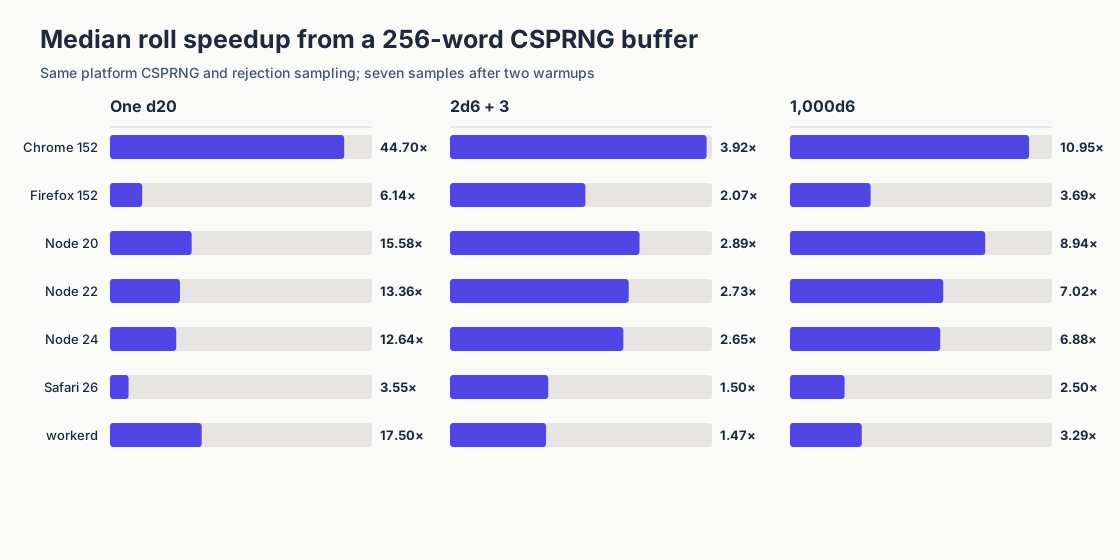
Why the platform fills 256 words at a time
A benchmark across Node 20–24, Chrome, Firefox, Safari and workerd found that 256 words is the best balance between first-refill cost and complete-roll speed.
The one thing it cannot promise, and why, at rollful.dev/docs/explanation/fairness.
It has no rules of its own. It rolls dice and reports what happened. Whether a high roll is good, what a label stands for, whether a total passes or fails — all of that is the caller's.
Extracted from OpenFray, which routes every roll through one function so randomness has a single place to live and be checked. Everything that knew about OpenFray's subject matter was left behind. OpenFray is AGPL-3.0; these dice are MIT.
Any constructive contribution is welcome — a bug fix, a new way of rolling, a fix to the documentation, a test, a typo.
Everything you need is in CONTRIBUTING.md: setup, the commands, the code style, and what "done" means. AGENTS.md covers the decisions that are easy to undo by accident.
MIT © Nicola Mustone — see LICENSE.